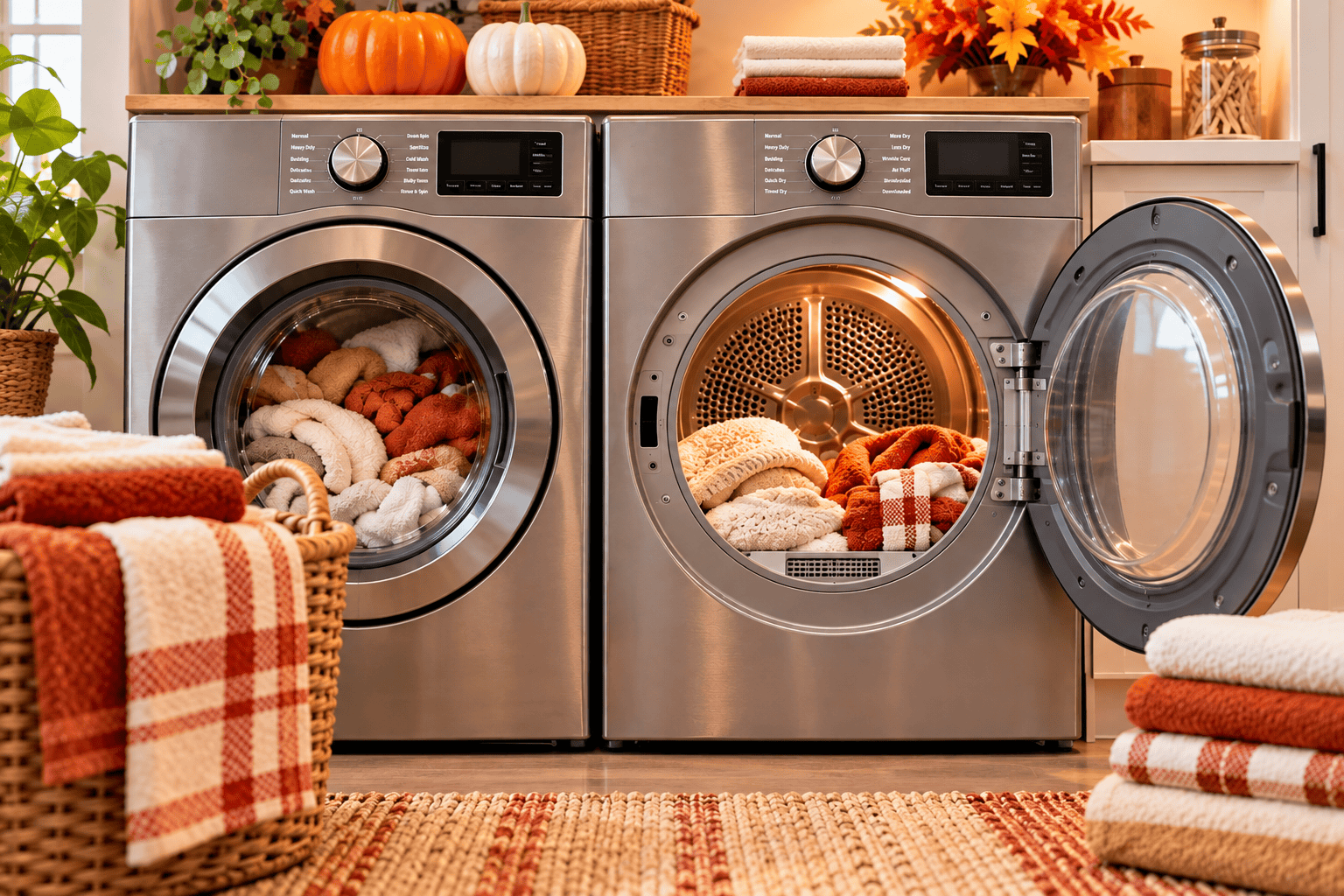
washer and dryer problems before Thanksgiving: Test laundry appliances early so towels, bedding, and table linens are ready for guests.
Thanksgiving appliance planning usually starts in the kitchen, but households hosting overnight guests often put extra pressure on the laundry room too. Guest bedding, towels, tablecloths, cloth napkins, kitchen towels, and last-minute clothing loads can turn the washer and dryer into essential holiday appliances.
Washer and dryer problems before Thanksgiving can derail that preparation. A washer that will not drain or spin can leave a full load soaked. A dryer that suddenly takes two cycles can create a backlog when you are trying to prepare beds and linens.
Test both appliances before holiday week becomes hectic. Appliance Cowboys’ guide to signs it is time to service your washing machine and dryer provides a useful starting point for symptoms that deserve attention.
Why Laundry Appliances Matter Before Thanksgiving
Hosting guests creates a different laundry schedule from a normal week. You may wash guest sheets several days before arrival, towels the day before, table linens after the meal, and additional bedding once guests leave.
Families with children or large gatherings may run even more loads. A small problem that is manageable during an ordinary week becomes more disruptive when several loads must be finished on a deadline.
Testing early gives you time to identify maintenance issues, schedule repair, and avoid overloading a struggling machine.
1. The Washer Is Not Draining
A washer that finishes with water in the tub may have a drain-hose problem, pump obstruction, filter issue, lid or door sensing problem, or failed drain component depending on the model.
Start with safe user-level checks from the owner’s manual. Make sure the drain hose is not visibly kinked and that the drain setup has not been changed.
Do not reach into pump areas or remove panels unless the manufacturer identifies those steps as owner maintenance.
Appliance Cowboys’ guide to a washer not draining explains common causes and what to check before calling for repair. If standing water repeatedly remains after a cycle, address the problem before loading guest bedding.
2. The Washer Is Not Spinning
A washer that drains but does not spin properly can leave clothes excessively wet.
An unbalanced load may prevent normal high-speed spin. Heavy blankets, towels, or sheets can bunch together and trigger balance protection.
Redistribute the load and follow the washer’s capacity guidance. If normal loads repeatedly fail to spin, the cause may involve a lid or door lock, belt, motor, control, suspension, sensor, or another component.
Appliance Cowboys’ article about a washer not spinning covers the most common symptoms and repair considerations.
3. The Washer Is Shaking or Banging
Some movement during spin is normal, but severe walking, banging, or repeated imbalance warnings are not.
Confirm that the washer is level and stable according to manufacturer instructions. Avoid mixing one very heavy item with several light items.
If the machine has recently become much more violent during spin, worn suspension components, bearings, leveling issues, or other mechanical problems may be involved.
Stop a washer that moves far enough to pull on hoses or the power cord.
4. The Washer Is Leaking
Water around a washer can come from supply hoses, drain hoses, door seals, detergent dispensers, pumps, internal hoses, or excessive suds.
Inspect visible hose connections and the area around the machine. Do not continue running loads if water is reaching electrical outlets or spreading under flooring.
Use the correct type and amount of detergent. High-efficiency washers require HE detergent when specified.
A leak that returns after basic checks should be diagnosed before Thanksgiving laundry begins.
5. The Washer Smells Bad
Front-load washers and some other designs can develop odors when moisture and detergent residue collect in seals, dispensers, or the tub.
Follow the manufacturer’s cleaning cycle and maintenance instructions. Wipe accessible gasket areas and leave the door positioned as recommended between uses.
Do not mix cleaning chemicals. Chlorine products combined with acids or ammonia can create dangerous gases.
If odor remains after proper cleaning or is accompanied by drainage problems, the machine may need further inspection.
6. The Dryer Is Taking Too Long to Dry
Long drying time is one of the most important dryer symptoms to address before a holiday.
An overloaded dryer, incorrect cycle, blocked lint screen, restricted vent, heating problem, airflow issue, or sensor problem can all increase drying time.
Clean the lint screen before every load. Make sure the exterior vent is not visibly blocked.
Appliance Cowboys’ article on signs of a clogged dryer vent explains warning signs such as long drying times, excessive heat, and poor airflow.
A dryer that needs two or three cycles for ordinary loads wastes time precisely when holiday laundry is piling up.
7. Clothes or the Dryer Feel Excessively Hot
Excessive heat can be related to restricted airflow, thermostat or sensor problems, heating-system faults, or overloading.
Stop using a dryer that smells burned, scorches fabric, or becomes abnormally hot.
Dryer vent maintenance is also a safety issue. Appliance Cowboys’ article on dryer vent cleaning and fire prevention explains why lint and restricted exhaust deserve attention.
Do not treat unusually high heat as a shortcut to faster drying.
8. The Dryer Is Not Heating
If the drum turns but clothes remain cold and wet, confirm the selected cycle is supposed to use heat.
Electric dryers can have heating-element, thermostat, fuse, power-supply, or control problems. Gas dryers can have ignition, gas-valve, sensor, or other heating-system issues.
Some electric dryers can tumble with partial electrical power while lacking the voltage needed for the heating circuit.
Do not open electrical or gas components for DIY testing unless you are qualified.
9. The Dryer Is Squeaking, Grinding, or Thumping
New noises can indicate worn rollers, idlers, belts, bearings, blower components, or foreign objects.
Check pockets before washing and drying because coins, fasteners, and small objects can create noise or damage.
A rhythmic thump may have a different cause from a high-pitched squeal or grinding sound. Note the sound and when it occurs.
Appliance Cowboys’ guide to a squeaking dryer explains why persistent noise should be investigated instead of simply tolerated.
10. The Dryer Will Not Start
Check that the door closes completely and that the selected cycle is correct.
A failed door switch, thermal fuse, control, motor, belt-related switch, power issue, or other component can prevent startup.
If a breaker trips repeatedly or the dryer smells electrically hot, stop resetting power and arrange service.
A dryer that is unreliable before Thanksgiving is unlikely to become more dependable when several loads are waiting.
Prepare Guest Bedding Without Overloading the Machines
Comforters, blankets, and large bedding can exceed the capacity of some household washers and dryers.
Check the manufacturer’s load guidance. A bulky item needs room to move, wash, rinse, and spin correctly.
An overloaded washer may fail to balance or drain effectively. An overloaded dryer can restrict airflow and produce uneven drying.
If an item is too large for the machine, use an appropriately sized commercial laundry appliance rather than forcing it into a residential unit.
Prepare Table Linens Early
Do not wait until Thanksgiving morning to discover a washer stain, dryer heat, or wrinkle problem on a tablecloth you need that afternoon.
Wash and dry table linens several days ahead according to their care labels.
This spreads laundry demand across the week and leaves capacity for guest towels and unexpected loads. It also means a developing washer or dryer problem becomes visible while there is still time to arrange service.
A Pre-Thanksgiving Washer and Dryer Test
Run a normal load several days before guests arrive.
For the washer, confirm normal filling, agitation or tumbling, draining, and spinning. Check the floor for leaks and listen for new mechanical sounds.
For the dryer, clean the lint screen, run an ordinary load, and compare drying time with normal performance. Check for excessive heat, burning odor, or weak exhaust airflow.
Do not perform invasive tests simply for holiday preparation. Observation during normal use provides useful information.
Check the Dryer Vent Before Heavy Holiday Laundry
A restricted dryer vent can increase drying time and heat.
Inspect accessible vent areas and the exterior termination if it can be done safely. Never climb into unsafe locations to inspect ductwork.
If the vent has not been professionally cleaned in a long time, or if warning signs are present, schedule appropriate service.
The dryer and vent system work together. Replacing dryer parts will not correct a severely restricted exhaust path.
Reduce Holiday Laundry Bottlenecks
Spread large loads across several days instead of planning every sheet, towel, and table linen for the night before guests arrive.
Finish guest bedding first, then towels and table linens. Leave time for each load to complete normally rather than overfilling the machines to save a cycle.
If drying time begins increasing from one load to the next, stop and investigate instead of continuing to stack wet laundry. A clean lint screen, proper load size, and unrestricted exhaust are basic checks that can prevent a manageable issue from becoming a holiday backlog.
Also keep the area around the washer and dryer clear. Extra luggage, boxes, and holiday storage should not block appliance ventilation, doors, hoses, or access to shutoff points.
When to Stop DIY Troubleshooting
Homeowner maintenance should stay within manufacturer-approved tasks such as lint-screen cleaning, simple hose inspection, load balancing, and cleaning cycles.
Stop if the washer leaks near electrical components, the dryer smells burned, breakers repeatedly trip, gas odor is present, wiring is damaged, or repair requires internal disassembly beyond your training.
Appliance Cowboys’ guide on when to skip DIY and call a professional can help define that boundary.
Should You Repair the Washer or Dryer Before Thanksgiving?
A minor symptom can become a major inconvenience when holiday laundry volume increases.
If the washer repeatedly fails to drain or spin, leaks, bangs severely, or stops mid-cycle, arrange diagnosis before loading guest bedding. If the dryer needs multiple cycles, overheats, will not heat, or produces persistent mechanical noise, address the problem before relying on it for towels and linens.
Waiting until the appliance completely fails can leave wet laundry trapped in the washer or a pile of damp towels with no practical way to finish them.
Thanksgiving Washer and Dryer Checklist
✓ Run a normal test load before holiday week.
✓ Confirm the washer fills, drains, and spins normally.
Check visible hoses and the floor for leaks.
✓ Balance bulky loads and stay within capacity.
✓ Use the correct detergent.
Clean the dryer lint screen before every load.
✓ Compare drying time with normal performance.
Check for excessive dryer heat or burning odors.
✓ Watch for unusual squeaking, grinding, or thumping.
✓ Inspect accessible dryer-vent areas safely.
Prepare guest bedding and table linens early.
✓ Arrange repair if symptoms persist.
Washer and Dryer Repair in Houston Before Thanksgiving
Washer and dryer problems before Thanksgiving can create unnecessary work when you are already preparing the house, kitchen, and guest rooms.
Appliance Cowboys services washers, dryers, and other major household appliances in the Houston area. If the washer will not drain or spin, the dryer takes too long, a leak develops, or either machine shows electrical or mechanical warning signs, professional diagnosis can help restore dependable operation.
Testing the laundry room now gives you time to prepare clean bedding, fresh towels, and table linens before guests arrive instead of troubleshooting appliances during the holiday.
Related reading: clogged dryer vent warning signs.
Related reading: dryer vent fire prevention.