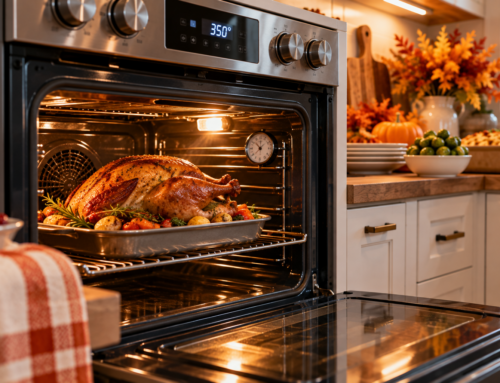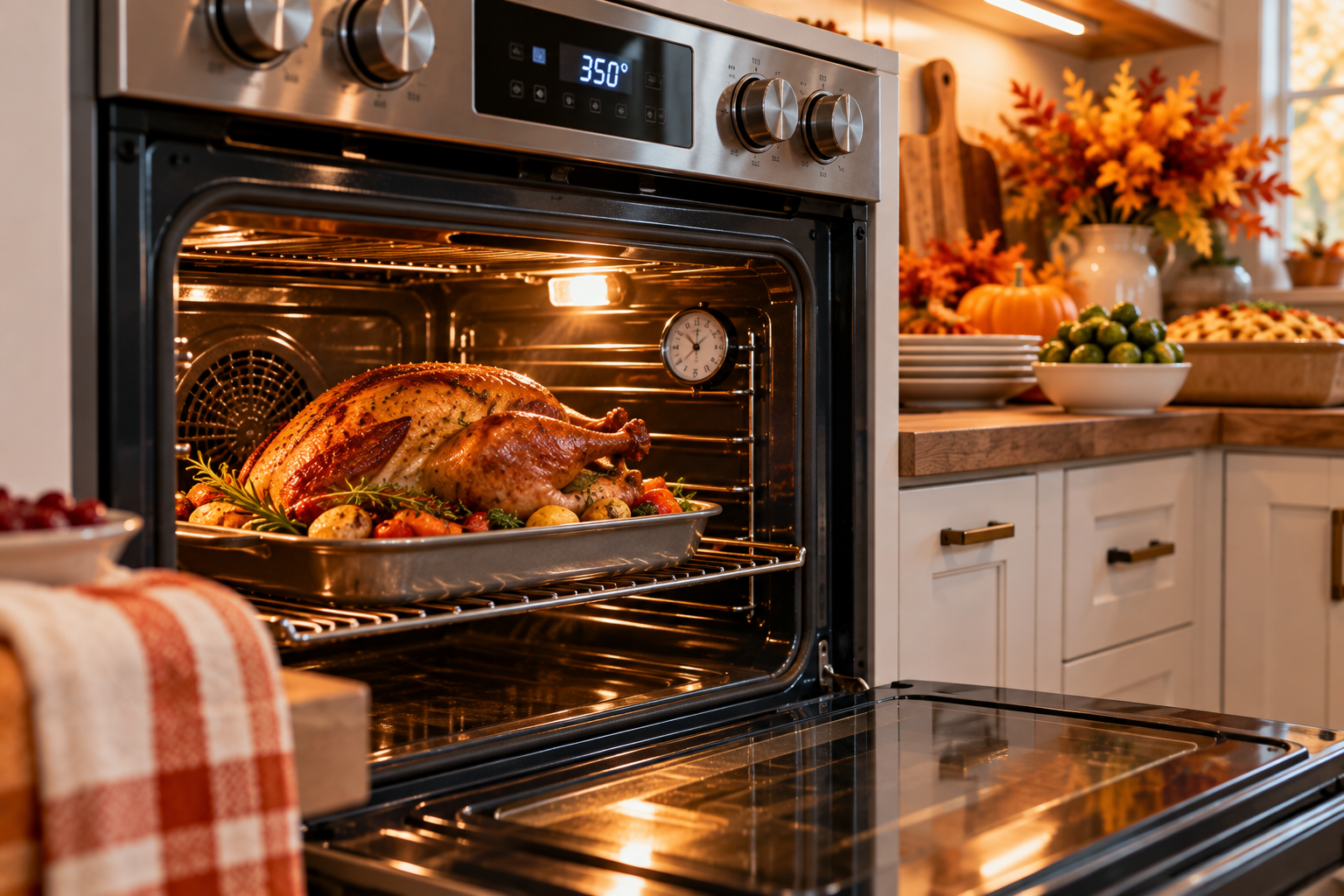
oven cooking unevenly before Thanksgiving is a concern for Houston homeowners preparing holiday meals. This guide covers the warning signs, safe checks, and when professional appliance repair is appropriate.
Thanksgiving depends on predictable oven temperatures. Turkey, casseroles, rolls, pies, vegetables, and reheated side dishes may all need oven time, often on a tight schedule. If your oven is cooking unevenly before Thanksgiving, a problem that seemed minor during ordinary meals can become much more noticeable when several dishes must finish at the right time.
Uneven browning, food burning on one side, unusually long cooking times, or temperatures that do not match the setting can point to loading issues, rack placement, a heating element, igniter, sensor, door seal, calibration, airflow, or another component. Test the appliance several days before the holiday and use Appliance Cowboys’ pre-Thanksgiving oven preparation guide as part of your kitchen check.
Why Uneven Oven Cooking Matters on Thanksgiving
Holiday recipes often depend on both temperature and timing. If one part of the oven is significantly hotter than another, a casserole can brown on top while remaining undercooked in the center. Rolls may burn near one side of the cavity. Pies can bake unevenly, and a turkey may take longer than expected.
Some temperature variation is normal because ovens cycle their heating systems on and off. The concern is a consistent pattern that is noticeably different from the appliance’s normal performance.
The goal is not to make every square inch of an oven identical. It is to identify abnormal behavior before Thanksgiving cooking begins.
1. Confirm the Oven Is Fully Preheated
Putting food into an oven before it reaches the selected temperature can create uneven results.
Wait for the normal preheat indicator, tone, or display. Some ovens continue stabilizing for a short period after the indicator first appears, especially after the door has been opened.
If preheating suddenly takes much longer than it used to, that can be a separate warning sign. A weak element, gas igniter, sensor, or power issue may affect how quickly the appliance reaches temperature.
Do not compensate for slow preheating by simply increasing the temperature setting.
2. Check Rack Position
Rack position can change how food cooks.
A pan placed too close to a heating element may brown faster on one surface. Large pans can also change airflow through the cavity.
Follow the recipe and appliance manufacturer’s recommendations for rack placement. If cooking multiple dishes, leave appropriate space between pans so heated air can circulate.
Avoid covering entire racks with foil. That can interfere with airflow and may damage some oven surfaces.
3. Look at the Bake Element
In many electric ovens, the bake element provides much of the heat used during normal baking.
A visibly damaged element may have blistering, cracks, burned areas, or a section that does not glow when the design normally allows the element to be seen.
Do not touch or test an energized element. Disconnecting power and electrical diagnosis should be left to qualified service when the task goes beyond visual observation.
A failing element can create long preheat times, weak bottom heat, and uneven cooking.
4. Consider the Broil Element
The upper element may contribute to temperature control or specific cooking modes depending on the oven design.
If the broil element is damaged, some foods may brown differently than expected. Convection and combination modes can also use heating components differently.
Test only normal functions you understand and follow the owner’s manual.
If one cooking mode works while another consistently fails, tell the technician exactly which mode shows the problem.
5. Gas Oven Igniter Problems Can Affect Heat
A gas oven may have an igniter that becomes weak before it fails completely.
The burner may take longer to ignite, heating may be delayed, or the oven may struggle to maintain temperature. Appliance Cowboys’ information about a Viking oven not heating shows how ignition-related problems can affect gas oven performance.
Do not attempt to repair gas valves, igniters, or gas connections unless you are qualified.
If you smell unburned gas, stop using the appliance, follow appropriate gas-safety procedures, and seek professional assistance.
6. The Temperature Sensor May Be Inaccurate
Many ovens use a temperature sensor to help the control system regulate heat.
If the sensor is damaged, out of position, or electrically faulty, the oven may run hotter or colder than intended.
Do not bend or relocate the sensor unless the manufacturer specifically instructs you to do so.
A technician can compare sensor behavior and oven temperature to determine whether the problem involves calibration, the sensor, wiring, or the control system.
7. Check the Door Gasket
Heat escaping through a damaged door gasket can affect temperature stability.
Inspect the gasket for tears, hardened sections, loose areas, or visible gaps. Make sure food debris is not preventing the door from closing completely.
Do not slam the oven door or place heavy objects on it.
If the gasket is damaged, use the correct replacement for the model. An improper seal can change cooking performance and increase heat loss.
8. Make Sure the Oven Door Closes Correctly
A gasket can be fine while the door itself is misaligned.
Worn hinges, damaged hinge receivers, or a bent door can prevent full closure. If the door appears uneven or requires unusual force to close, it should be inspected.
Do not continue using an oven with a door that will not remain closed.
Thanksgiving cooking may keep the oven running for hours, making a door problem more significant than during a short weekday meal.
9. Avoid Overcrowding the Oven
Trying to cook every side dish at once can create uneven results even when the oven is working normally.
Large pans can block circulation. Multiple cold dishes also absorb heat when they are first loaded, increasing recovery time.
Plan the cooking sequence before Thanksgiving. Group dishes with compatible temperatures and leave enough space for airflow.
If the oven performs normally with one pan but poorly only when completely packed, loading may be part of the problem.
10. Convection Fan Problems Can Affect Cooking
Convection ovens use a fan to circulate heated air.
If the fan stops, slows, becomes noisy, or is blocked, convection performance can change. Food may cook more slowly or unevenly.
Listen for unusual scraping or rattling when convection mode is operating.
Do not reach near the fan or remove protective covers while the oven is powered.
11. Compare Temperature Carefully
An oven thermometer can provide useful information, but one quick reading may be misleading because ovens cycle.
If you are checking temperature, allow the oven to stabilize and observe the pattern over time according to appropriate testing guidance.
A consistent large difference between the selected temperature and actual performance deserves attention.
Appliance Cowboys’ guide to an oven that is overheating covers several causes of temperature-control problems.
12. Watch for Repeated Burning on the Same Side
One burned casserole does not necessarily prove the oven is defective.
A repeated pattern is more useful. If cookies, rolls, or casseroles consistently brown much faster on one side despite correct rack placement and pan position, document it.
That pattern can help identify airflow, element, fan, or heat-distribution issues.
Rotate pans only when the recipe allows it. Rotation can help cooking results, but it should not be used to hide a severe appliance problem.
Test the Oven Before Thanksgiving
Bake a familiar food several days before the holiday.
Use the normal rack position and temperature you typically use. Observe preheat time, browning, and cooking duration.
Listen for unusual noises and make sure the door closes normally.
This test is more useful than discovering a temperature problem when the turkey is already in the oven.
Appliance Cowboys’ oven maintenance tips can help with additional routine preparation.
Plan for a Thanksgiving Oven Emergency
Even a well-maintained appliance can fail unexpectedly.
Know which dishes can be prepared earlier, reheated another way, or cooked on a different appliance when safe and appropriate.
Do not attempt risky electrical or gas repairs during the holiday simply to keep the meal on schedule.
Appliance Cowboys’ guide on what to do if your oven stops working on Thanksgiving Day provides additional emergency planning.
When to Stop DIY Troubleshooting
Basic rack adjustment, cleaning, visual gasket inspection, and temperature observation are reasonable homeowner checks.
Stop when diagnosis requires live electrical testing, gas-system work, element replacement, control-board work, or internal disassembly beyond your training.
Burning odors, sparks, damaged wiring, repeated breaker trips, or gas odors require immediate attention.
Appliance Cowboys’ guide on when to skip DIY and call a professional can help establish that boundary.
Thanksgiving Oven Checklist
✓ Run a test bake before Thanksgiving.
✓ Confirm normal preheat time.
✓ Use recommended rack positions.
✓ Leave space around large pans.
✓ Inspect the door gasket.
✓ Confirm the door closes completely.
✓ Watch for repeated uneven browning.
✓ Listen for abnormal convection-fan noise.
✓ Do not ignore delayed gas ignition.
✓ Document temperature problems.
✓ Avoid unsafe DIY electrical or gas repairs.
✓ Arrange repair before Thanksgiving if performance remains abnormal.
Oven Repair in Houston Before Thanksgiving
An oven cooking unevenly before Thanksgiving can disrupt the timing of the entire meal. If the appliance runs too hot, too cold, or creates a consistent hot spot, diagnosing the problem before the holiday is much easier than trying to compensate while several dishes are cooking.
Appliance Cowboys services ovens and other major kitchen appliances in the Houston area. Heating elements, igniters, sensors, fans, seals, controls, and door components can all affect cooking performance.
Test your oven now. If it cannot produce predictable results during an ordinary meal, Thanksgiving is not the day to hope the problem disappears.
Related appliance repair guidance: oven overheating.
Related appliance repair guidance: Whirlpool uneven cooking.
Related appliance repair guidance: oven taking too long to preheat.